Adding gutter services to an existing contracting business costs far less than starting a gutter company, because you already carry the licence, the insurance and a truck.
Most contractors sub the first few installs to a gutter crew and bring the work in-house only once the schedule justifies a machine. Licensing usually does not change: according to SRS Building Products’ Tim MacVeigh, the permits, licensing and insurance a roofer already carries generally cover gutter work written into the same contract — confirm that with your own state board before you sell the first job.
Sub it out or buy a machine?
Three routes, and the right one depends on your schedule rather than your ambition:
- Sub the first installs. Lowest capital, lowest control. You learn the job on someone else’s crew, keep the customer relationship, and give up the fabrication margin.
- Buy through a distributor who forms it for you (chop-and-drop). Mid-way: you sell and install, someone else owns the machine. Margin sits between subbing and full fabrication.
- Buy the machine. $5,000–$12,000, plus coil, plus training, plus a person who owns the quality. Justified when you are running enough linear feet per month to keep it busy.
The mistake is buying the machine before the schedule exists. A machine that runs twice a month is a payment, not an asset.
What changes in licensing, permits and insurance
Usually nothing, when the gutter work is written into a contract you are already licensed to perform. Tim MacVeigh of SRS Building Products puts it plainly: the licensing, permits and insurance you use for roofing are the same ones you need for gutters, on the same contract.
The exceptions that actually bite:
- A separate contract. Sell the gutters as a standalone job and you may find yourself doing unlicensed work, because the classification that covered the roof does not cover a separate gutter contract.
- States that require a sheet-metal or roofing specialty classification for fabrication work, regardless of who holds the general licence.
- Insurance exclusions. Check that your general liability does not exclude exterior sheet-metal installation, and that the completed-operations cover extends to it.
None of this is a reason not to do it. It is a reason to make one phone call before the first sale.
Adding gutter services to a roofing business
Roofing is the natural entry point, because the two jobs share the same moment: the roof is off, the fascia is exposed, and the homeowner is already spending. Attach the gutter at contract stage rather than trying to sell it after the roof is finished.
Operationally:
- Price it as one number. A roof plus gutters quoted together reads as a complete job; the same work quoted separately reads as an upsell.
- Sequence the trades. Gutters go on after the roof is complete and before the landscaping conversation. On a re-roof, the fascia is the cheapest access you will ever have.
- Keep one crew accountable. If you sub the first installs, the sub reports to your foreman, not to the homeowner.
- Decide the guard question early. Offering guards changes the ticket, the warranty conversation and the callback rate.
Adding gutter services to a siding, window or remodeling business
“Home exterior” is not a trade — the trades are roofing, siding, windows, painting and remodeling, and the gutter call arrives differently in each:
- Siding and trim crews find the fascia and soffit already exposed. If the fascia is being wrapped or replaced, the gutter is coming off anyway — quote the replacement at the same time.
- Window replacements put you at the same elevation with the same ladders. The homeowner is already buying exterior work; the gutter conversation is one question, not a campaign.
- Remodelers see the roofline change. New rooflines mean new runs, and a customer already committed to a six-figure project is not price-shopping a gutter.
Want to hold the product before you commit to a line?
The GutterDome Dealer Kit has the tri-fold brochure, postcard and product samples — the fastest way to see whether this fits the work you already do.
Adding gutter services to a home improvement business
Home-improvement contractors are the widest and least gutter-adjacent group. The fit is a bundled exterior package — roof, gutter, guard, fascia — sold as one exterior envelope, not a standalone gutter division. If your average job is a kitchen or a bathroom, adding gutters means adding a crew, not adding a line item, and the maths rarely works until you are doing exterior work at volume.
Adding gutter services to a pest control business
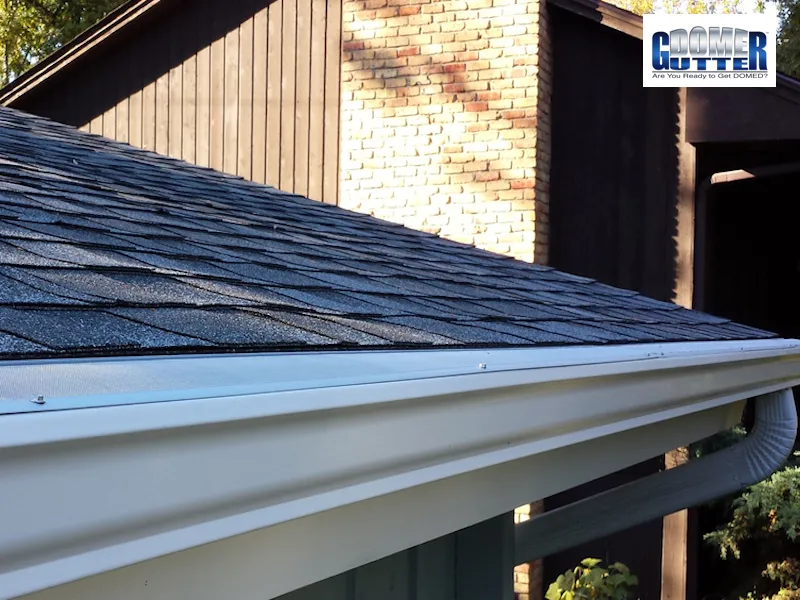
Pest control is the one trade on this list whose crews are already inside the same customer relationship, on the same ladders, at the same address. What that gives you is the two things a guard install actually needs: the truck, and neighbourhood density that is already built — not a route to go and find. What a pest calendar does not give you is a season that lasts. Outdoor and mosquito work peaks in the warm months, and the calls that start in the fall are about water: a run that will not drain, a stain under the roofline, a corner of the roof a customer has been watching all year. Gutter protection is the counter-season line — a one-day install on a house your crew already visits, quoted from the same driveway, on a product you fit once and do not come back to service.
Two things are worth saying plainly, because they protect the sale. It is a drainage product, not a mosquito product. A guard keeps debris out of the rain gutter so the run drains, and standing water is where mosquitoes breed — so a draining run removes a breeding site. But no customer should ever be told a guard replaces a treatment programme; the moment it is oversold that way, the callback is yours. And the install has to be the whole run. A partial install leaves the same habitat in the gaps, which is the one complaint you do not want attached to a line you have just added.
If you run pest routes and you are weighing this up, the question to answer first is not what the product costs — it is what your crews are doing between November and March, and what you say today when a customer calls about a stain under the roofline that no one can bill for. A gutter line answers both with the same visit: paid work in the shoulder season, and a call your existing technician can hand to a crew already on the property.
Gutter guards: the second line item on the same job
The gutter install is the entry. The guard is where the job becomes a system — and where the margin is. Per SRS’s Tim MacVeigh, leaf protection can add roughly 30% on top of the gutter job. That figure is a distributor’s observation, attributed, not a promise.
Why guards change the economics rather than just the invoice:
- They convert a maintenance job into a one-time purchase. The homeowner is buying the end of a chore, not a length of metal.
- They carry a warranty conversation. A 30-year lifetime warranty on a fabricated system is a different sale from commodity mesh, and it justifies the ticket.
- They reduce callbacks. The complaint that kills gutter reputations is the clog, and the guard is the answer to it.
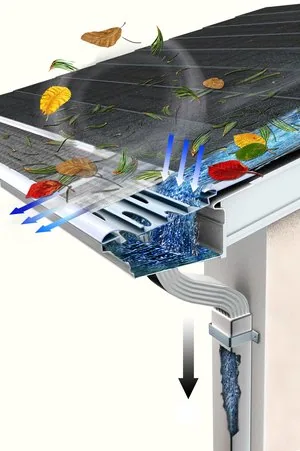
- They are one SKU line, not a catalogue. Extruded aluminium with stainless micro-mesh, in six sizes, covering 4–7 inch gutters.
If you are going to carry a product line rather than fabricate commodity gutter, the GutterDome wholesale and Dealer program is the manufacturer-direct route: protected DMA territory, Dealer pricing, and no franchise fee. The comparison that matters if you are weighing it against a franchise is on the franchise alternative.
Sources
- rooferscoffeeshop.com — Tim MacVeigh, SRS Building Products, on licensing continuity and the ~30% leaf-protection uplift.